

Advancing a greener future: How six Sheridan research projects are driving sustainable innovation
 Apr 22, 2026
 As the world recognizes April as Earth Month, there is growing momentum to develop practical, scalable solutions that support a more sustainable future.
Through applied research and collaboration with industry and community partners, Generator at Sheridan is tackling real-world environmental challenges such as reducing energy use, advancing clean technology and empowering communities to take climate action.
From smart infrastructure to renewable energy, six applied research projects demonstrate that innovation — when guided by purpose — can help turn ambitious climate goals into achievable solutions.
Smarter manufacturing for energy-efficient window framing
Generator at Sheridan’s Centre for Intelligent Manufacturing (CIM) partnered with Vision Coatings Limited, a leading provider of finishing services for the fenestration industry in North America, on the project ‘Process Optimization for Insertion of Heat-Resistant Insulation Materials’ to modernize the production of energy-efficient window frames.
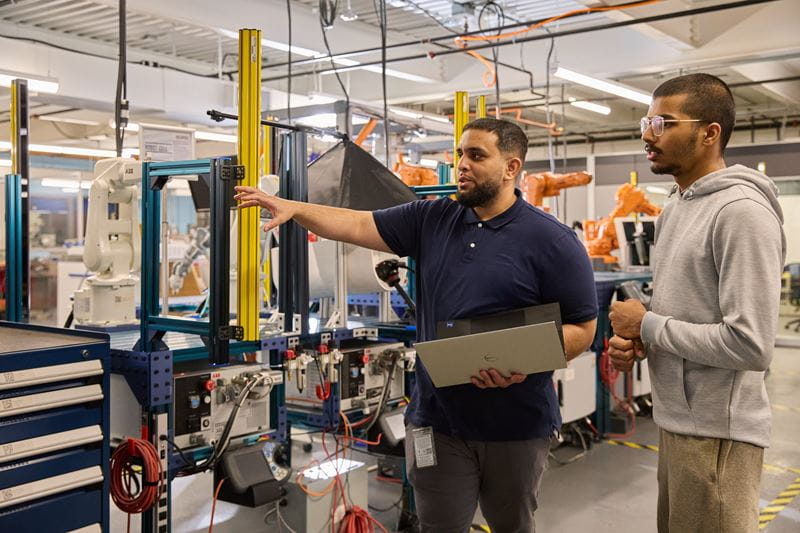
Supported by a Federal Economic Development Agency for Southern Ontario (FedDev) Southern Ontario Network for Advanced Manufacturing Innovation (SONAMI) grant, CIM Research Manager Dr. Ethan Shen and CIM Research Technologist Mohamed Kasim developed an automated system for inserting heat-resistant aluminum foam insulation, replacing a manual process that was slow, inconsistent and posed safety risks.
The system uses integrated sensors and dual operator control panels to automatically pull insulation through frame cavities up to 21 feet long, creating a safer, more efficient, and highly repeatable workflow with minimal manual intervention. This advancement enables Vision Coatings Limited to scale production significantly, increasing output while enhancing the thermal performance of vinyl window frames — ultimately helping to reduce heat loss in buildings and lower overall energy consumption.
AI-enabled sustainability data automation
Generator at Sheridan’s Centre for Applied AI (CAAI) and carbon accounting company, CarbonSuite are collaborating to streamline sustainability reporting that will support more informed strategies for reducing environmental footprints.
Supported by a FedDev SONAMI grant and led by CAAI Research Manager Dr. Haruna Isah, the project ‘SONAMI 3.0 Cohort 2B – CarbonSuite Inc.’ works to address a key barrier in sustainability reporting: the challenge of collecting and standardizing fragmented data from multiple sources such as invoices, Enterprise Resource Planning (ERP) systems and external emission factor databases.
Through the development and testing of AI-driven tools to automate and integrate data, as well as map and publish emission factors within a centralized database, the initiative reduces manual effort, improves data accuracy, and minimizes compliance risks. This ultimately accelerates decision-making and enables more effective, data-driven sustainability strategies.
Using virtual reality to inspire climate action
Generator at Sheridan’s Screen Industries Research & Training (SIRT) Centre collaborated with the Oakville Community Foundation to develop a short virtual reality experience set in a future Oakville impacted by climate change that will inspire environmental action.
Supported by an Natural Sciences and Engineering Research Council of Canada (NSERC) Mobilize Seed Fund grant, the research team, led by SIRT Film Production Specialist Kevin Santos and CGI Specialist Valentina Bachkarova, created an immersive storytelling experience to highlight how simple, everyday actions — like buying local food or conserving water — can have a cumulative impact on the environment.
Participant feedback showed that VR made climate issues feel more immediate and personal, empowering users to take action and demonstrating how emerging technologies can drive behavioural change and strengthen community engagement in sustainability efforts.
Sustainable greenhouse design for food security
To address food insecurity and the environmental challenges of northern agriculture, CIM and Sheridan’s Faculty of Applied Science & Technology (FAST) partnered with AgriTech North, a B-Corp social enterprise focused on year-round local food production, to assist with the development of new vertical greenhouse technology that will enable sustainable operations and significantly improve current farming methods.
Funded by an NSERC Mobilize Seed Fund grant and led by FAST professors Dr. Amin Ghobeity and Dr. Joaquin Moran, the project ‘Evaluation of Thermal Models for a Greenhouse System’ used advanced modelling software to design a greenhouse capable of reducing energy consumption. The work incorporates a multi-layer ethylene tetrafluoroethylene cushion system and hybrid photovoltaic/thermal (PVT) solar panels to optimize growing conditions while minimizing energy use.
This innovation supports year-round local food production in remote regions of Northwestern Ontario, reducing reliance on long-distance food transport while lowering the environmental footprint of agriculture.
Augmented reality accelerating clean energy adoption
SIRT collaborated with Toronto-based clean energy innovator Morgan Solar on the project ‘Augmented Reality Simulation of Solar Blind Control’ to merge cutting-edge augmented reality (AR) technology with sustainable design.
Funded by an NSERC Applied Research and Development (ARD) grant and led by SIRT’s former Software Engineer Lead Mike Darmitz, researchers developed an AR application that simplifies the adoption of solar shading technology, allowing users to visualize and simulate the performance of solar window blinds in real-world environments. By overlaying 3D models onto buildings and factoring in sun position, location and seasonality, the tool improves planning accuracy and customer confidence. The app’s real-world coordinate tracking and spatial anchoring also enables highly accurate placement, which is critical for complex installations.
This innovation not only supports the scaling of Morgan Solar’s Energy Blinds, but also highlights how digital tools can remove barriers to implementing sustainable building solutions.
Advancing next-generation wind energy
CIM and clean energy company Wind Enairgy recently conducted a FedDev SONAMI- supported applied research project to develop the Dual-Axis Cascaded Airfoil Wind Turbine (DACAWT), a novel approach to wind energy generation. The research team, led by Dr. Shen and FAST professor Dr. Nadim Arafa, designed the DACAWT prototype to allow for higher aerodynamic efficiency, reduced noise, minimum risk to wildlife like birds and bats, and effective turbine performance even in low-wind conditions.
Beyond reducing reliance on fossil fuels, the DACAWT also has the potential to deliver affordable, sustainable power — particularly for off-grid and remote communities — and to support the economic growth and development of skilled jobs in Canada’s renewable energy sector.
Smart infrastructure through IoT innovation
To modernize outdoor infrastructure with smart technology, CIM collaborated with industry partner HCI Lighting on the project ‘Flagpole Automation and Software UI Development.'
Supported by an NSERC ARD and led by Dr. Shen, the research team developed an Internet of Things (IoT)-enabled flagpole system that integrates sensors, adaptive lighting and remote operation — allowing flagpoles to respond to ambient conditions and be controlled centrally via an internet-connected platform.
By improving energy efficiency, reducing maintenance and enhancing safety, the project demonstrates how even traditional infrastructure can evolve into smarter, more sustainable systems. With a scalable design, the project also paves the way for the broader application of smart infrastructure across public and commercial spaces.
Building a more sustainable future — together
These projects reflect a shared commitment to advancing sustainability through applied research — where collaboration between academia, industry and community partners leads to tangible environmental and economic benefits. By pairing real-world challenges with Sheridan’s applied research expertise and state-of-the-art facilities, partners are able to integrate emerging technologies such as AI, advanced materials and data-driven systems into existing operations.
Whether improving energy efficiency, expanding access to clean power or inspiring individuals to take climate action, each initiative contributes to a more resilient, low-carbon future. And this Earth Month, they serve as a powerful reminder of how applied research can turn ambition into action — driving measurable environmental outcomes while delivering practical, scalable benefits for partners and communities alike.
Interested in learning more about how Generator at Sheridan is developing innovative solutions for today’s most pressing challenges? Visit sheridancollege.ca/generator

Media Contact
For media inquiries, contact Sheridan’s Communications and Public Relations team.