
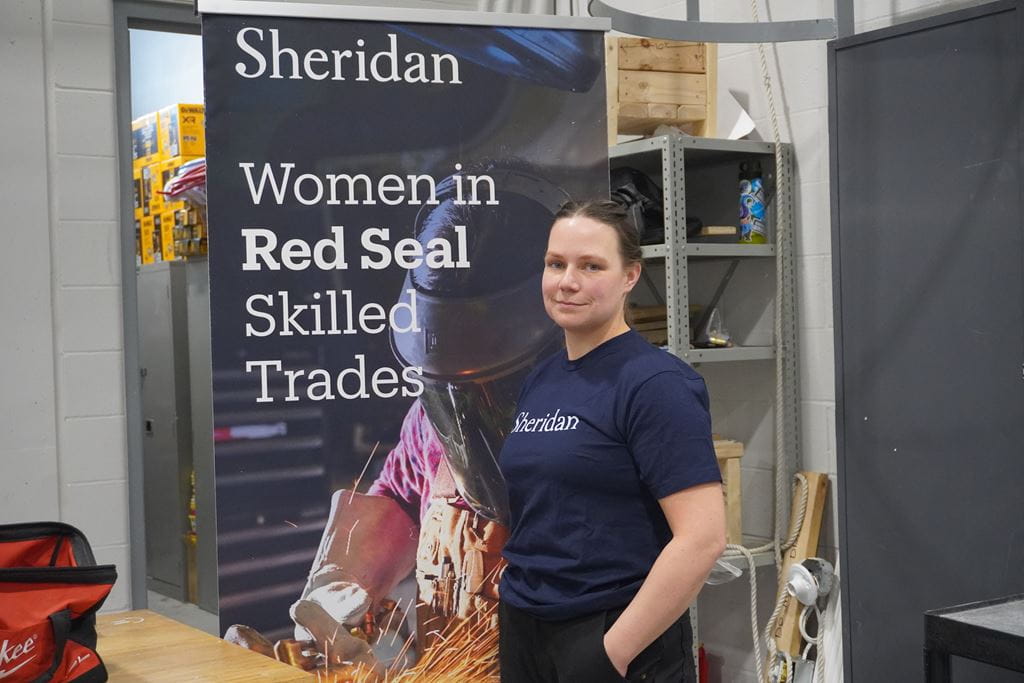
Supporting tradeswomen with a recipe for success
 Mar 5, 2026
 As a high school student, Kelsey Annan had many traits that aligned with a career in the skilled trades.
A curiosity about how machines work? Check. An ability to follow instructions to create something tangible? Check. A sense of satisfaction derived from being given a task and quickly seeing it through to completion? Check.
There was one missing ingredient, however, that led Annan to become a pastry chef instead: a defined path she and fellow women could follow to pursue a skilled trades career.
“There was an auto shop class in high school that I would have loved to take, but I didn’t because I was told by my peers that ‘girls don’t take that class’. It wasn’t until I was able to convince a friend to take a manufacturing course with me in Grade 11 that I felt it was okay to take a trades-related course, and I think it was the best mark I ever got in high school,” Annan says.
“But even then, high school never really presented a trades career as an option for girls. There was no one providing a map for us of how to get there. I ended up leaning into baking instead because high school provided us with co-op opportunities at a bakery.”
“Just having one person acknowledge that I could work in a skilled trade was all I needed.”
Annan went on to earn a diploma in pastry arts, then worked in a bakery for a couple of years. Although she wasn’t making very much money and felt “stuck”, she didn’t reconsider the potential of entering the skilled trades until her father, a tradesman who could sense his daughter’s unhappiness, simply stated, ‘I think you’d make a good millwright.’
“Just having one person acknowledge that I could work in a skilled trade was all I needed. I immediately began researching what millwrights do, completed a pre-apprenticeship program, did my three levels of apprenticeship training at Sheridan, and dove right in,” Annan recalls.
Within a year, she began working as a tool and die maker at Martinrea International, a global auto parts manufacturer. After that, she spent 12 years working at Massiv Die Form, a new-build shop in Brampton that produces dies for major original equipment manufacturers (OEMs). And today, Annan manages the Women in Red Seal Skilled Trades – Advancing the Career Ecosystem program, a collaborative initiative led by Sheridan in partnership with three other colleges and Unifor, Canada’s largest private sector union.
“Our goal is to ensure that any females interested in pursuing the skilled trades feels supported and sees a pathway forward. Yes, they may still be the only woman in their class, but we’ll help them see that there are other women out there doing the same thing, and that we’re always happy to talk and listen and provide whatever support they need,” Annan says.
We recently sat down with Annan to learn more about her journey into the skilled trades, her work with the Women in Red Seal Skilled Trades program, the industry recognition she recently received for her support of tradeswomen, and more.
Why was acknowledgement or encouragement from one person enough for you to pursue a career in the trades?
I grew up loving LEGO. I loved the Popular Mechanics for Kids magazine. I loved it when something was on the brink of breaking, because it meant I could take it apart and see how it worked. I even took machine shop in high school.
I immediately gravitated towards the tool and die field of the skilled trades because there it had so many similarities to baking. You're following a recipe, a series of steps to make something. As a baker, you're making a pie; as a tool and die maker, you're making a precision block. I just love that type of work, and the skilled trades were a chance to have financial security that I couldn't get as a baker.
Why do you think that women have always been so under-represented in the skilled trades?
I think that a lot of it is a mentality of 'I've never seen it, so it must not be possible.' Some manufacturing companies don't even have a women's changeroom, so it doesn't seem like an option.
I often talk to people about my experience working at a bakery, when I'd often be lifting 20-kilogram bags of sugar or flour, lugging them over my shoulder and dumping them into the industrial mixers. When you work in tool and die and go to lift 20kg of steel, you get in trouble because there are cranes and forklifts and pump trucks for that. People think the trades are dirtier and involve heavy lifting, but I say nursing is dirty and heavy lifting, and women do that all the time.
“People think the trades are dirtier and involve heavy lifting, but I say nursing is dirty and heavy lifting, and women do that all the time.”
Everyone knows about Canada's skilled labour shortage. The thing is, many women are excited and passionate and eager to enter the skilled trades, but a huge issue is retention. If the skilled trades aren't willing to adapt and change, women just leave. That was actually part of the reason I'm now managing this program at Sheridan. When I decided to start a family and things like shift work suddenly didn't work for me, I had to look for other opportunities.
How does your personal experience inform the way in which you now manage a program that supports female high school and college students pursuing a skilled trades education and career?
We run a lot of workshops in which we'll show female high school students how to do something really simple that they can then do themselves, using their own hands to accomplish something. I either try to lead those workshops or get some of our female students at Sheridan to participate because that representation really does make a difference. Seeing that another woman has pursued this career can make you see yourself doing it as well.
Prior to becoming the manager of the Women in Red Seal Skilled Trades - Advancing the Ecosystem program, you were a tool and die maker for 12 years. Do you miss doing that work?
100 per cent. I found the most fulfilment from working with the tools, from being given a task at the start of the day and then seeing how much you'd accomplished by the end of the day. It's such a rewarding feeling, and I miss it a lot.
I still get a lot of joy and happiness and accomplishment from the work I do with the Women in Red Seals - Advancing the Career Ecosystem program, but it's not the same. At the end of the day, I don't look at the 30 emails I sent and think 'amazing, look at what I did today.' I really love working in the trades, and there's still a chance I go back to it.
Women on Site, a not-for-profit support and advocacy group for women and underrepresented people in the skilled trades and other industries, recently named you as its first-ever WOS of the Year. What did this recognition mean to you?
 It's hard to describe the feeling, and I felt really emotional about it. I'm not doing this job for awards, but to have someone acknowledge the impact of our program and how much I truly care about supporting women in the trades was really meaningful to me.
How did you become involved with Women on Site, and what have you done to support that organization?
When the Women in Red Seal Skilled Trades - Advancing the Career Ecosystem program first started, we would go to career fairs with the hopes of promoting skilled trades to high school students. Whenever I attended these fairs and saw a fellow tradeswoman, I gravitated towards them and wanted to learn their story. One of the women I met was a bricklayer, and she told me about Women on Site.
Women on Site is exactly what I wish I'd had early on in my career — opportunity to meet other tradeswomen and connect over conversation. I find that a lot of mentorship programs for women in trades involve additional work, like reading a book and writing a report. Women on Site is more like 'Hey, we're all going to have dinner the first Wednesday of each month. If you can make it great. If you can't, maybe next month.' They also have WhatsApp groups, which is like having a group of 50 women in your pocket with whom you can celebrate achievements or get support after a bad day.
“Women on Site is exactly what I wish I'd had early on in my career — opportunity to meet other tradeswomen and connect over conversation.”
When I first connected with Women on Site, I think they had nine chapters, and none between Toronto and Hamilton. It took me over an hour to get to a Toronto event and over an hour to get to a Hamilton event, so I decided to start a Mississauga chapter. We started with six people in October 2024, and our February 2026 chapter meeting had more than 20 people, so we're already growing.
Colleges are doing an amazing job with recruiting females to the skilled trades, and students have clubs and groups that they can participate in. But once these students leave college, the support isn't there. Organizations like WOS address that.
Last fall, the Duke of Edinburgh’s International Award Canada program recognized Women in Red Seal Skilled Trades – Advancing the Career Ecosystem as an Education Operating Partner. What was the significance of that recognition, and what led to it?
It’s very important to have a strong network when you’re looking for work in the skilled trades, and this recognition will allow our students to grow their networks through the award program’s alumni.
When I was looking at the requirements of being an Education Operating Partner — skill building, adventurous journeys, volunteer work — our students were already doing it. They volunteer their support in our workshops, our open houses and our recruitment events. We also host an annual event at Camp Ak-O-Mak, Canada’s largest competitive sports camp for girls, where female administrators, faculty, skilled tradeswomen and students work together to open the camp and build or repair equipment and facilities.
I thought ‘Okay, our students are already doing this work, so why don’t we find another way to reward them for it?’ That reward is being part of a large international alumni network that can support them when they’re looking for a skilled trades apprenticeship.
Do you feel like your work with Women in Red Seal Skilled Trades and Women on Site is making a difference?
The data can be a little discouraging because you might be going from 40 women in the trades to 50 women in the trades. But while the numbers are still low, they are increasing.
Today (the day of the interview), we have a group of 24 girls from an area high school coming to Sheridan to do a skilled trades workshop. It will make an impact. There will be girls who participate in that workshop and realize ‘I enjoyed doing this and I can do this.’
I’ve had students come up to me here at Sheridan and tell me they’re here because they got to try welding here when they were in Grade 10. It’s hearing those stories that gives me encouragement.
Sheridan offers numerous trades and technology programs, including apprenticeship, plumbing, electrical, mechanical and engineering. Students apply their new skills in state-of-the-art facilities that feature industry-standard equipment used in the workplace. Learn about various other ways in which Sheridan’s skilled trades outreach programs are making a difference in our local communities.
– Photos by Almira Nanez, Sheridan social media specialist
Media Contact
For media inquiries, contact Sheridan’s Communications and Public Relations team.